The trading journal
that works on the trader,
not just the trades.
Import your trades. OscillaTrade finds the behaviour that is costing you money in your own history, hands it to a coach that interviews you about it instead of handing you a rule, and gives you one thing to work on this week.
OscillaTrade is a trading psychology journal for day and swing traders in futures, forex, stocks and crypto, including funded and prop-firm traders. The journal is $5 a month. Pro, at $49 a month, adds Patterns, the AI coach, The One Thing, the 24-week Master Key programme and the reset tools.
Cancel any time Pro trial: 30 days of everything for $8.99, then $49/month
The problem
A trading psychology journal starts where a trade log stops: the chain behind the trade.
The off-plan trade started three steps earlier.
The behaviour
The re-entry two minutes after a stop-out. The doubled size after a red day. The setup you watched go without you. Your history has these in it, and a spreadsheet will never point them out.
The emotion under it
Impatience, boredom, the need to make it back. You logged a mood at the open and a state on the trade. Nothing has ever read the two together.
The thought and the belief
"Waiting is wasting." "I should be further on by now." No data field holds these. Only a conversation reaches them, and a rule written on a sticky note does not.
OscillaTrade finds the first two links in your data and opens the conversation about the third.
Two minutes
The journal, the coach and the reset tools, in two minutes
The journal, the coach and the reset tools, walked through by our partner Asia Forex Mentor.
How it works
How the trading psychology journal works: one loop, every week
The journal reads your trades. Everything else reads the journal.
Step 1
Import or log
A CSV from Tradovate or NinjaTrader is recognised on sight; any other broker maps once. Or type a trade in, with the state you were in and the setup you took.
Step 2
Patterns reads it
Fourteen detectors compare the trades that fit a condition against the rest of your history, and show the sample size on every finding.
Step 3
The coach interviews you
Open a finding with the coach and it asks one question at a time, back from the behaviour to the emotion to the thought. No rule until you have named the belief.
Step 4
Pick The One Thing
Choose the behaviour for the week. The journal measures it from your trades and the check-ins ask about it morning and evening.
Step 5
Sunday, the summary
A weekly email with the week's numbers, the behaviour you chose, the check-ins you kept and one thing to look at.
Patterns · Pro
The behavioural patterns in your futures, forex, stock and crypto trades
Patterns does not compare you with other traders. It compares the trades that fit a condition with the rest of your own history, in your own money, and only says something once there are enough of them to mean it. Each finding shows the trades behind it, the emotions you logged on them and the mistakes you wrote.
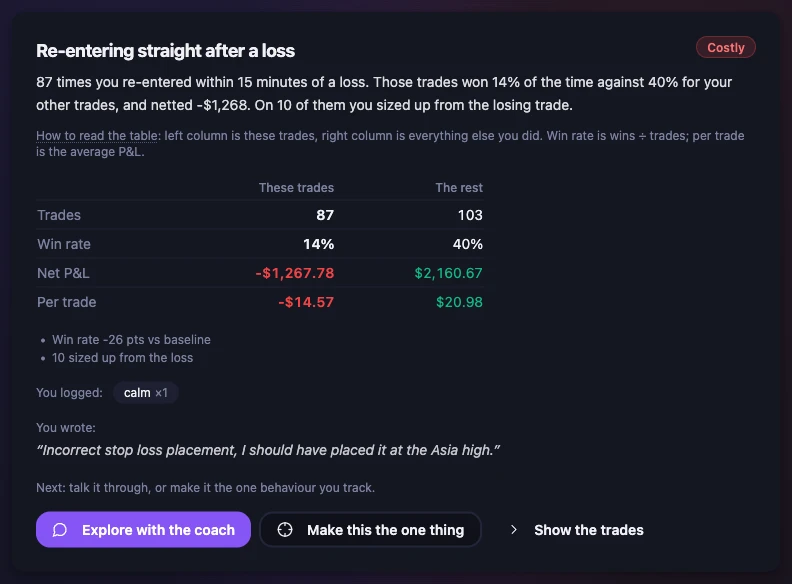
- Re-entering within minutes of a loss
- Off-plan trades, and when they cluster
- Size creeping up after a loss or a red day
- Overtrading days
- An hour of the day that loses
- The day after a red day
- Trading on a low-mood or low-focus morning
- Confidence that runs backwards
- Old identity versus new at the entry
- Behaviours the auto-tagger keeps naming
- What happens after a winning streak
- Giving back a green day
- Hesitating on setups you then watch work
- Winners cut short, losers held
23 trades opened within fifteen minutes of a losing exit. Together they lost more than the rest of the month made, at a win rate 21 points below your baseline. Size on those trades was above your usual on 17 of them.
Matched
23
Baseline
188
Logged
Frustrated · FOMO
AI trading coach · Pro
An AI trading coach that reads your trades and remembers what you told it
The coach sees your trades, your check-ins, your patterns and the behaviour you chose for the week, and it keeps notes across conversations. Opened from a pattern, it runs an interview rather than a lecture: one question at a time, from what you did to what you felt to what you were thinking, and it does not offer a rule until you have named the belief underneath in your own words.
- Reads your actual trades and check-ins, not generic advice
- Remembers earlier conversations and the beliefs you have named
- The chain interview, opened straight from a pattern
- Supportive and tough-love modes
- A tilt reset for the middle of a bad session
Coach
Chain interview
Twenty-three re-entries inside fifteen minutes of a loss, and you logged "frustrated" on most of them. Take the last one. What was the thought, right before you clicked?
That I couldn't end the day down on a setup I'd read right.
"Couldn't end the day down." What would ending the day down have meant about you?
Working on it · Pro
Trading discipline: one behaviour this week, one practice for 24 weeks
The One Thing
Pick a single behaviour to work on for the week: take every valid setup, honour the stop, no re-entry after a loss, hold to target, stay under a daily count, keep the size, avoid the hour that loses, stick to the plan. The journal measures it from the trades you log and shows the week against your baseline. The morning check-in asks what you will do about it; the evening one asks whether you did.
- Eight measurable behaviours, chosen from your own patterns
- A weekly series against your baseline
- Asked about in the daily check-in and known to the coach
The Master Key
A 24-week course in mental discipline built on Charles Haanel's 1912 Master Key System, one practice per week: stillness, attention, then the harder work of directing thought under pressure. Each week unlocks when the previous one is done, and you can restart from any week you have reached, so a missed month is not a lost programme.
- 24 weeks, one practice each, gated week by week
- A daily practice with a short reflection
- Restart from where you stopped
Reset tools · Pro
Reset tools for tilt, a loss streak and the afternoon after a bad morning
Guided sessions for the stress of trading, drawn from three performance-psychology traditions. They are exercises, not treatment, and every one says what it is doing and why.
Reset after a bad day (EMDR-inspired)
Guided bilateral stimulation, visual or audio, with mood and confidence logged before and after. Protocols for a loss streak, pre-session nerves and the reset after a drawdown. EMDR as a clinical technique is recognised by the WHO and the NHS; these sessions borrow its structure for performance, and are not therapy.
Work on a belief (NLP practitioner)
Anchoring for a pre-trade focus state, pattern interrupts for the spiral, a belief audit with replacement statements, and visualisation for execution. A practitioner session generated from what you write about your own trading.
Calm down fast (EFT-inspired tapping)
Guided audio with tapping-point diagrams, and sessions built from the specific issue you name. Session history is kept so you can see what you have used and when.
Also in Pro
A journal for funded and prop-firm traders, with partners and a calendar
Who you're becoming
An identity blueprint that names the trader you are becoming, and a morning and evening practice that asks whether today matched it.
Adaptive calendar
Your practices, check-ins and reviews laid out over the morning, moved when the week goes badly, with a feed for your own calendar app.
Prop-firm tracking
Multiple funded accounts, rule templates from the prop firm, drawdown against the limit, payouts, and a debrief when a funded account is lost.
Accountability partners
Match with another trader, share a playbook or a trade, and check in on each other. Coach conversations are never shared.
Compared
OscillaTrade compared with spreadsheets, analytics journals and mindset apps
A spreadsheet or an analytics journal
TradeZella, Tradervue, Edgewonk: records and charts the trades
- Trade log, tags and analytics
- Charts the trade, not what came before it
- No conversation about the thought behind it
- Nothing to work on next week
A mindset app
Works on the person
- Reset and reflection tools
- Never sees a trade
- Cannot tell you when the behaviour happens
- Not built for the trading day
OscillaTrade
Reads the trades, works on the trader
- The journal, with import and playbooks
- Patterns found in your own history
- A coach that interviews rather than instructs
- One behaviour a week, measured
- The reset tools, beside the trades
Read
Trading psychology, with the sources
Pricing
Trading journal pricing: Journal $5 a month, Pro $49 a month
The journal on its own, a paid month of everything, or Pro. Cancel any time from your account; export your data on any plan.
Pro
$490/year, billed annually
- The journal, plus everything below
- Patterns: 14 detectors on your own history
- The AI coach, with memory and the chain interview
- The One Thing and the 24-week Master Key
- EMDR-, NLP- and EFT-inspired reset tools
- Identity blueprint, adaptive calendar, prop-firm tracking, partners
Virtual EMDR charges $79–$139/mo for its EMDR programme alone (verified August 2026). Pro includes EMDR-inspired sessions beside the journal, the patterns and the coach, in one place.
FAQ